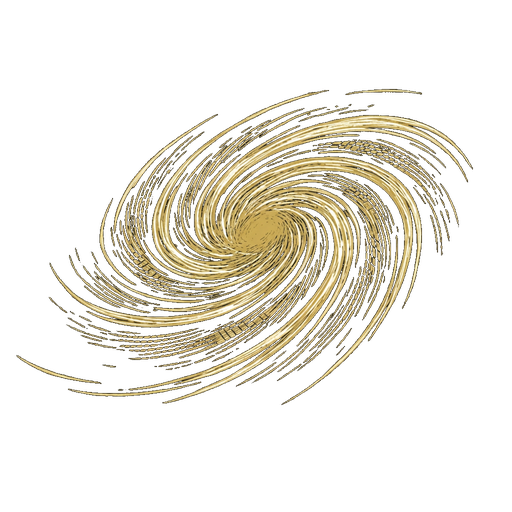
Humanity Just Found the Milky Way’s Edge And Earth’s Closer Than We Thought
By tracking ancient giant stars, astronomers have traced a fuzzy, long‑hidden boundary where the Milky Way’s star‑forming disc ends that is only tens of thousands of light‑years beyond our own Sun.

Friday, June 26, 2026

Juliancolton, CC BY-SA 4.0, via Wikimedia Commons
EARTH, Laniakea Supercluster—For ages, astronomers have been charting the chronological odyssey of our galaxy. By exploring the outer limits of the Milky Way, they’ve determined where its story begins to fade out.
Turns out, it’s basically a senior center for the stars.
A recent study published in Astronomy and Astrophysics reveals that the edge of the Milky Way is unfortunately not coated in chocolate; but instead a vast, ancient region where star formation drops off sharply and old stars reign in peace. This marks the point where the Milky Way’s star-forming region, or “star-forming disc,” ends; it’s been difficult to detect because instead of stopping abruptly, it essentially leaks into deeper space.
This is the tricky part. Researchers isolated the signature of "inside-out" growth, which told them where the youngest stars exist at the outermost part of the Milky Way, well, up to a certain point.
Our galaxy follows a kind of natural rule where older stars live toward the center and newer stars spread outward over thousands of light-years, but at around 35,000 to 40,000 light-years from the Galactic Center, a reverse card gets pulled and old stars begin to dominate. The result is a distinct U-shaped age profile for the galaxy: old, young, then old again—a celestial breadcrumb trail that pointed researchers toward the edge and confirmed where baby-star formation drops off.

To confirm their breakthrough finding, a team of international scientists led by Dr. Karl Fiteni based at the University of Insubria combined spectroscopic data (the chemical and light fingerprint) on bright giant stars from the LAMOST and APOGEE surveys with precise measurements from the Gaia satellite, which is mapping the Milky Way in unprecedented detail. They matched it up against detailed simulations, and—eureka—the galaxy gets a wonky, star-studded, checkered finish-line.
“The extent of the Milky Way’s star-forming disc has long been an open question in Galactic archaeology; by mapping how stellar ages change across the disc, we now have a clear quantitative answer,” remarked Dr. Karl Fiteni in a statement published by ScienceDaily.
When looking back at history, it becomes obvious that uncovering the edge of the Milky Way was no small feat; in fact, puzzling together this prevailing mystery involved analyzing more than 100,000 of the great-great-great-grandparents of our star system. The tech used to collect that data is a clear testament to what’s available to scientists in the modern era.
“In astrophysics, we use simulations run on supercomputers to identify the physical mechanisms responsible for the features we observe in galaxies,” explained Dr. João A. S. Amarante from Shanghai Jiao Tong University. In this study, he added, “they allowed us to demonstrate how stellar migration shapes the age profile of the disc and to identify where the star-forming region ends.”

Think about this powerful data from the stars like a railgun for space exploration, and by uncovering the edge of our galaxy’s stellar nursery, its laser precision could help untangle the cosmic mystery that is the Milky Way’s beginnings.
These elderly stars, plotted and cross-checked by supercomputers, are universal lighthouses shedding light on humanity’s next steps in a new era of galactic discovery.
Sources

About Marc Alexander
Journalist. Out exploring cosmic rabbit holes.
Read More

How to Build a Universe in a Bottle
Humanity
Before There Were Planets, There Was Sugar: New Discovery Rewrites Life’s Origin Story
Universe
The Best Way to Find Aliens? Watch for the Ones Hoarding Their Own Sun
Universe
NASA’s New Dark Universe Telescope Sets Off to Map the Hidden Cosmos
Universe
Lunar Customs: Why Some Scientists Want a Port of Entry on the Moon
Earth
Astronomers detected a powerful cosmic 'UFO'. It’s not what you think
Universe
AI Just Found 118 Hidden Worlds in NASA’s Data
Tech
On a Planet With No Sunrises & No Sunsets, Scientists Hunt Life in the Twilight
Universe
Do Aliens Think We’re Ghosting Them?
Universe
27 Tatooines: Astronomers Spot New Worlds With Double Suns in Our Own Galaxy
Universe
Lost in Space: Microgravity Makes Sperm Lose Their Sense of Direction
Universe
Alien Space Weather Stations Orbiting Distant Stars Could Tell Us Where Life Exists
Universe
‘Forbidden’ Black Holes: How the Biggest Stars Die Without a Trace
Universe
“Ancient Immigrant”: The Cosmic Time Capsule Drifting Through Our Galaxy
Universe
Mars Kept Its Water Hidden for Billions of Years. Humans May Have Discovered Its Hiding Spot.
Universe
A Massive Star Vanished Without a Trace. Astronomers Finally Know Why.
Universe
Betelgeuse Has a Lydia Too: Hubble Just Discovered the Red Supergiant's Secret Companion Star
Universe
Lemon Shaped Jupiter-Sized Planet Discovered
Universe
She Left Her Wheelchair on Earth and Floated Among the Stars
Humanity