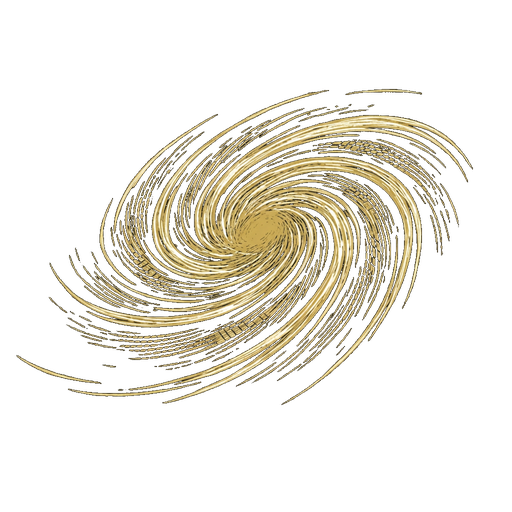
The Milky Way’s Glowing Heart: Is Dark Matter Finally Waving Hello?
A stubborn glow at deep in the Milky Way Galaxy’s core just got a lot weirder.

By Ethan Denma
Sunday, November 2, 2025

EARTH, Laniakea Supercluster—A strange, persistent glow is beaming out of the heart of the Milky Way galaxy, and new research is making physicists rub their cosmic hands, wondering if it might be the first selfie of dark matter blowing itself up.
Astronomers using the Fermi Gamma‑ray Space Telescope have been tracking a curious surplus of gamma-rays deep in the bulge of the Milky Way, known as the Galactic Center GeV Excess (GCE). Now, new simulations from a team led by Moorits Mihkel Muru suggest that the glow could be the audible ping of dark matter particles colliding and annihilating each other.
“Dark matter dominates the universe and holds galaxies together. It’s extremely consequential and we’re desperately thinking all the time of ideas as to how we could detect it,” said astrophysicist Joseph Silk of Johns Hopkins University in
new research published in October in the journal Physical Review Letters.
“Gamma rays, and specifically the excess light we’re observing at the center of our galaxy, could be our first clue,” said Silk.
For more than a decade scientists have wrestled with two viable culprits behind this glow: a swarm of ancient, rapidly-spinning neutron stars (called millisecond pulsars) or this very dramatic possibility: self-destructing dark matter. The pulsars would leave a “boxy” glow pattern while dark matter annihilation was expected to be smoother and spherical. But here’s where things get odd.
Muru’s team found that if the dark matter halo is flattened from past galactic mergers, it could also produce a boxy pattern, so the usual shape-argument is no longer a knockout blow against dark matter.
That means we’re in cosmic ambiguity: the glow could be millisecond pulsars lighting up, or it could be the universe’s most massive players finally exposing themselves. Either way, the stakes are huge. If the dark matter interpretation holds, it could represent the first indirect detection of a substance that makes up roughly 27 percent of the Universe’s mass-energy.
Don’t break out the bubbly just yet though.
Silk said “a clean signal would be a smoking gun, in my opinion.”
But that hasn’t happened yet.
“It’s possible we will see the new data and confirm one theory over the other. Or maybe we’ll find nothing, in which case it’ll be an even greater mystery to resolve,” Silk wrote.
A mysterious glow—maybe old stars ticking away; maybe dark matter blowing itself to smithereens. In the intergalactic game of hide-and-seek, the universe just winked, and humans are left scrambling to figure out what kind of wink it was.

Read More

These Fungi Could Turn Martian Dust Into Farmland
Tech
How to Build a Universe in a Bottle
Humanity
Before There Were Planets, There Was Sugar: New Discovery Rewrites Life’s Origin Story
Universe
The Best Way to Find Aliens? Watch for the Ones Hoarding Their Own Sun
Universe
NASA’s New Dark Universe Telescope Sets Off to Map the Hidden Cosmos
Universe
Lunar Customs: Why Some Scientists Want a Port of Entry on the Moon
Earth
Astronomers detected a powerful cosmic 'UFO'. It’s not what you think
Universe
AI Just Found 118 Hidden Worlds in NASA’s Data
Tech
On a Planet With No Sunrises & No Sunsets, Scientists Hunt Life in the Twilight
Universe
Humanity Just Found the Milky Way’s Edge And Earth’s Closer Than We Thought
Universe
Do Aliens Think We’re Ghosting Them?
Universe
27 Tatooines: Astronomers Spot New Worlds With Double Suns in Our Own Galaxy
Universe
Lost in Space: Microgravity Makes Sperm Lose Their Sense of Direction
Universe
Alien Space Weather Stations Orbiting Distant Stars Could Tell Us Where Life Exists
Universe
‘Forbidden’ Black Holes: How the Biggest Stars Die Without a Trace
Universe
“Ancient Immigrant”: The Cosmic Time Capsule Drifting Through Our Galaxy
Universe
Mars Kept Its Water Hidden for Billions of Years. Humans May Have Discovered Its Hiding Spot.
Universe
A Massive Star Vanished Without a Trace. Astronomers Finally Know Why.
Universe
Betelgeuse Has a Lydia Too: Hubble Just Discovered the Red Supergiant's Secret Companion Star
Universe